All storiesPublished 2 min read
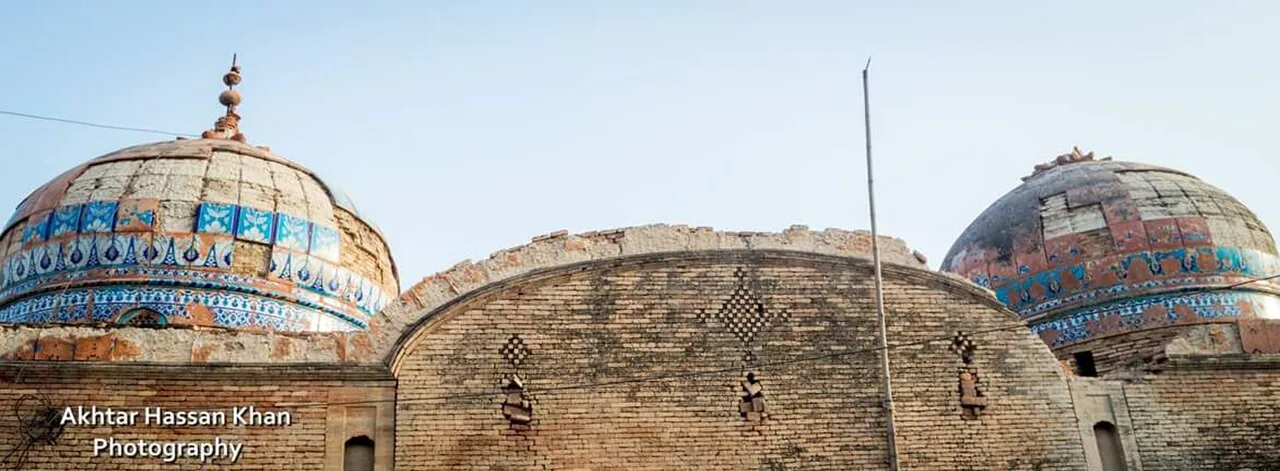
The 1908 district gazetteer placed Daira Din Panah seven miles north of Kot Addu and five from the Indus, on the road to Dera Ismail Khan. Over the town stands “a fine domed building covered with blue and white tiles”: the tomb of the saint the town is named after. Tradition gives his name as Syed Abdul Wahab Bukhari. The 1908 gazetteer calls him a Bukhari Sayyid who had settled here three hundred years earlier; the 2019 edition says he came from Afghanistan about four hundred years ago.
A foundling, a dowry, two shrines
The gazetteer records the legend as it was told. He was raised by Mai Suhagin, wife of Akku, a Makwal Jat, who had found him as a child on the bank of the Indus. He gave her property away in charity, and when her daughter Rabi was married to a man from Sanghar he offered himself as her dowry. He is said to have died in 1012 AH on the west bank. The Makwals of the two banks then quarrelled over his coffin until he appeared in a dream — and since then, the gazetteer says, there has been a shrine on each bank of the Indus.
Two more legends travel with the shrine. One says Emperor Akbar came disguised as a sanyasi, offering a lock of his hair to become a disciple, and was refused. Some local accounts go on to say Akbar built the tomb; the 1908 gazetteer instead credits a camel-driver, Mian Haran, who was said to find as much money as he needed in his camel's saddle every evening. Both are legends, not records — no source gives the tomb a construction date.
Hindus and Muslims alike
In 1908 the tomb was a place of pilgrimage for Hindus and Muslims alike, and a favoured place for a child's first haircut. Pilgrims came in the months of Har and Bhadra from across the district and from Bhakkar, Leiah, Dera Ismail Khan, Jhang and Montgomery; offerings came to about Rs 8,000 a year. The gazetteer also noted that some tiles had been replaced and others were fading. In 1909–10 the Deputy Commissioner of Muzaffargarh, Hari Kishan Kaul, undertook a major rehabilitation of the tomb.
The shrine today
The Makwals, descended from Mai Suhagin, are still its keepers, and the head of the family is called the makhdum. The Auqaf Department took the shrine over on 23 July 1960, and the 2019 gazetteer gives the urs as 21–22 August each year. Its condition is a worry: in 2019 Dawn reported that Auqaf had declared the building dangerous, that there was no security, and that four of the shrine's seven kanals of land were under illegal occupation.
Sources
Facts in this story come from the sources below. Spotted an error? Write to hello@kotaddu.pk.